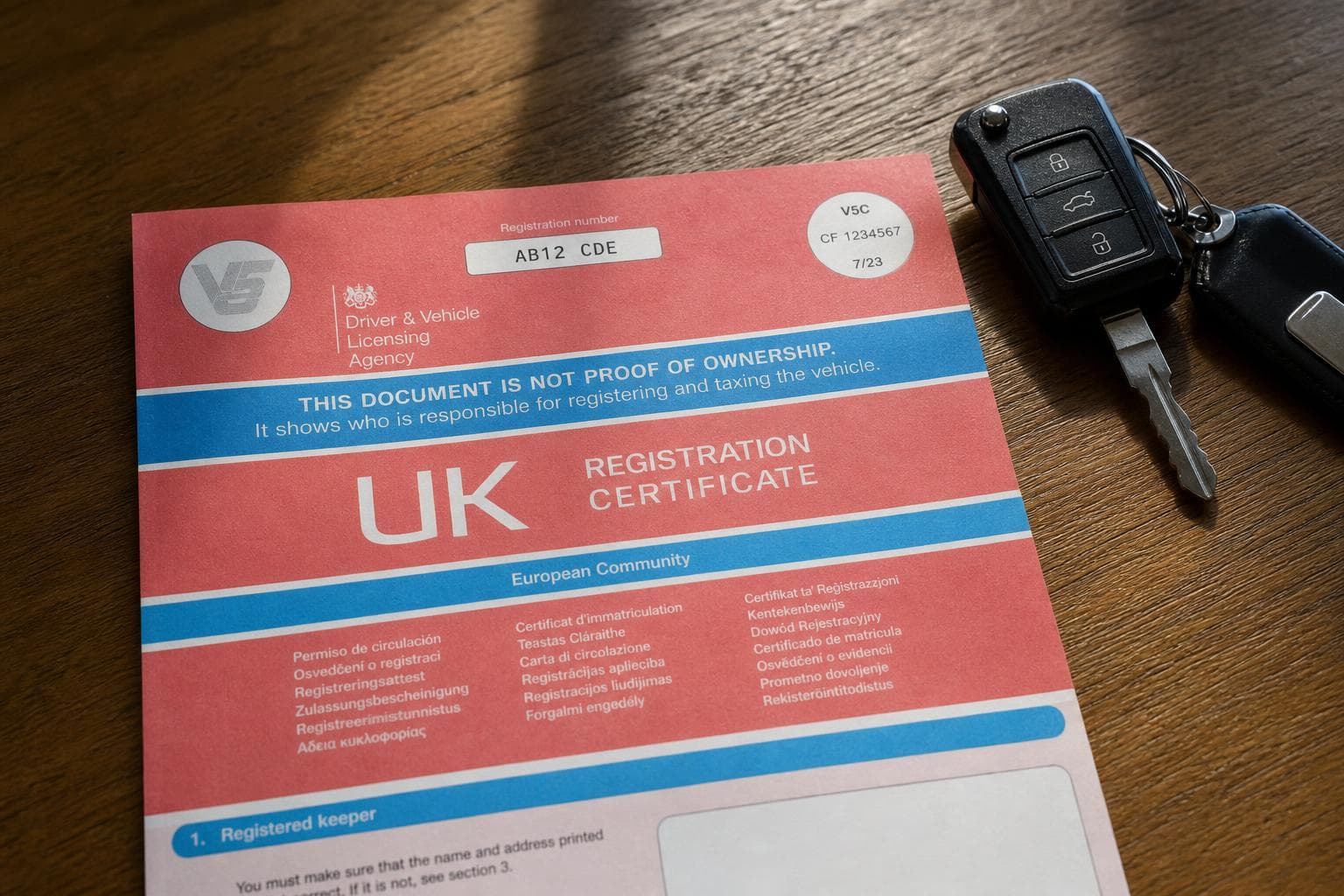
The V5C is the document most buyers focus on. It is often called the logbook - the name is informal, but the official name is V5C and you will hear the two used interchangeably. It contains more information than most people realise, and checking it properly takes less than five minutes.
What the V5C Contains
The V5C records:
- The registered keeper's name and address
- The vehicle make, model, and colour
- The VIN (Vehicle Identification Number)
- The engine number and size
- The date of first registration
- A full list of previous keepers (number of, not their names)
- The document reference number
Critically, it shows the number of previous keepers and when the current keeper registered it. That timeline is useful context.
V5C is Not Proof of Ownership
This is the most important thing to understand about the V5C.
The V5C records the registered keeper - the person responsible for taxing and licensing the vehicle. The registered keeper is not necessarily the owner. A fleet company may be the keeper while a director uses the car. A finance company may retain ownership while the driver is listed as keeper.
If a seller presents a V5C and claims it proves they own the car, they are wrong. Ownership is a separate legal matter. Run a finance check to confirm no outstanding hire purchase, PCP, or logbook loan exists against the vehicle.
How to Check the V5C When Viewing a Car
Do this before you hand over any money.
Check the VIN on the document matches the VIN on the vehicle. The VIN is stamped on a plate in the engine bay and also appears on a sticker inside the driver's door frame. On most cars it is also visible through the windscreen at the base of the dashboard on the driver's side.
Check the engine number if you can access it. It is stamped on the engine block. The location varies by manufacturer.
Check the colour matches. Simple but often missed.
Check the document reference number format. It should be 11 digits. Cloned V5Cs often use incorrect formats.
Hold the document up to light and check for the DVA crown watermark pattern throughout the paper. Genuine V5Cs are printed on security paper.
Red Flags on a V5C
Many previous keepers in a short time - a car that has had five keepers in three years is worth questioning.
Keeper registered very recently - if the current keeper only registered the car days before listing it for sale, ask why.
Address mismatch - if the V5C address and the seller's address are completely different, ask for an explanation.
Handwritten alterations - any crossing out or handwritten changes to a V5C are not valid. The DVLA issues a new document for any changes.
No V5C at all - a seller claiming to have lost it may be genuine, but it is also a classic tactic when a car is stolen or cloned.
What to Do if There is No V5C
Do not complete the purchase without one.
You can apply to the DVLA for a replacement V5C (form V62, fee applies). Ask the seller to do this before you buy. If they refuse or create urgency, walk away.
A car with no V5C cannot be easily registered in your name and cannot be legally driven on a public road until you resolve the situation.
What Happens at the Point of Sale
When you buy a car, the seller must complete the relevant section of the V5C and send it to the DVLA. You should receive a new V5C in your name within a few weeks.
Keep the green new keeper slip (section 6) from the V5C at the time of purchase. This is your proof that you are the new keeper while the DVLA updates its records, and you will need it for taxing the vehicle.
Run a History Check Alongside the V5C
The V5C is a starting point, not a finish line.
A full vehicle history check at check.bad-drivers.uk verifies the identity data in the V5C against national databases, checks for outstanding finance, stolen markers, and write-off records that the V5C will never show.
The combination of a thorough V5C inspection and a history check covers the two main ways buyers lose money: document fraud and hidden financial or structural problems.
Useful Links
- Apply for a replacement V5C - GOV.UK - Form V62 for replacement logbooks
- Run a full vehicle check - Bad Drivers UK - Finance, stolen, write-off, keeper history and more
- Buying a used car - Citizens Advice - Your rights when buying used