A car history check shows you what is officially recorded about a vehicle before you hand over any money. Knowing exactly what does a car history check show helps you understand what risks you can rule out - and which ones you cannot.
Here is a breakdown of every section, from basic to full report.
What a Standard Check Shows
A standard check pulls from DVLA and DVSA records. It gives you verified, government-held data:
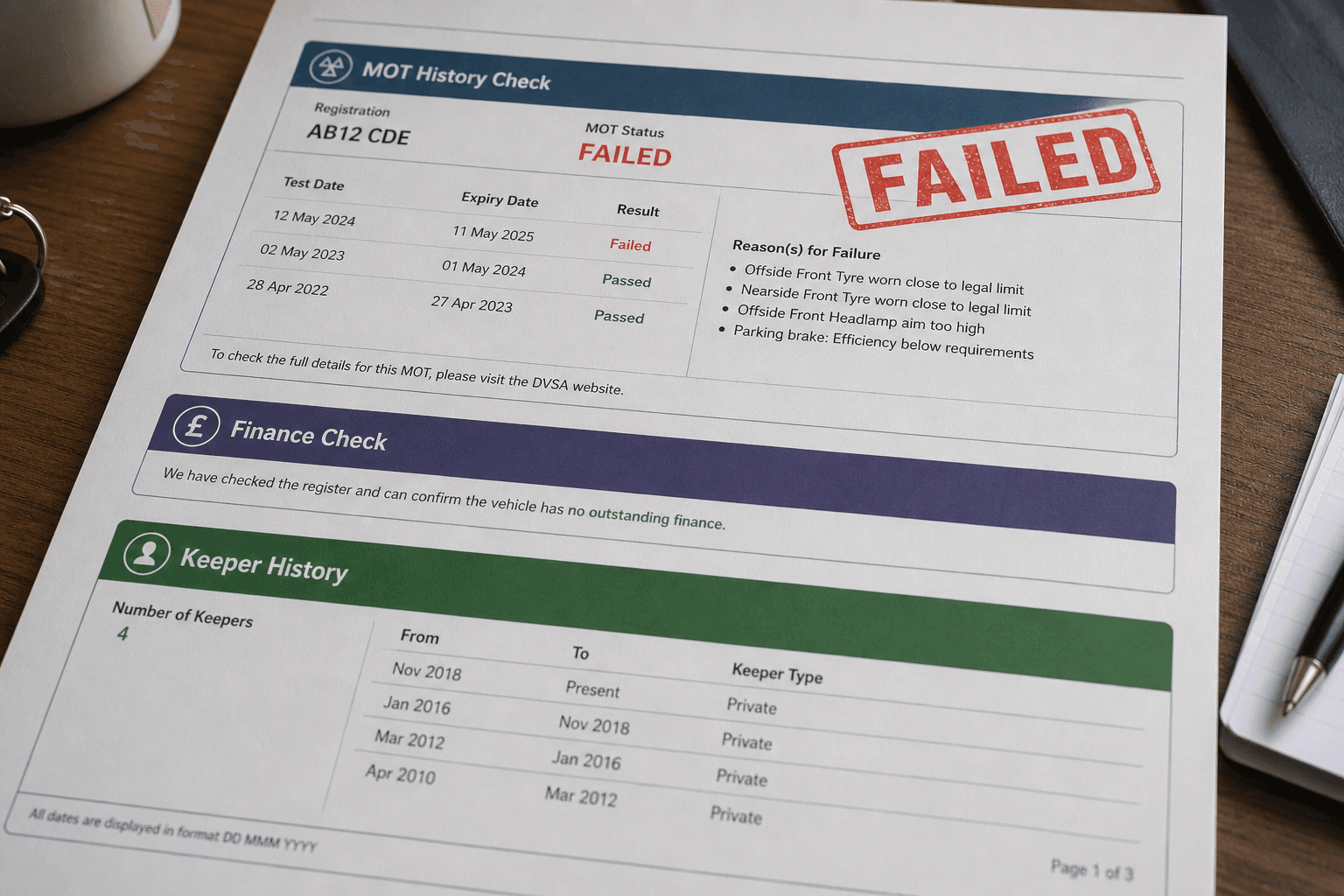
MOT history. Every test result, pass or fail, going back years. Each test includes the mileage recorded, any failure reasons, and any advisories. This is one of the most useful data points when assessing a car.
Current MOT status. Whether the car has a valid MOT and when it expires.
Tax status. Whether the car is taxed or on SORN.
DVLA registration data. The make, model, colour, fuel type, and engine size as officially recorded. Check this matches what the seller is showing you.
What a Full Check Adds
A full vehicle history check adds data from several additional databases. This is where the important findings come from.
Outstanding finance. This is the big one. If the previous owner took out a loan against the car and has not paid it back, the lender's legal claim on the vehicle follows the car - not the owner. You could buy the car in good faith and still lose it to the finance company. A full check searches the main UK finance registers to flag any recorded agreements.
Stolen vehicle check. Searches the Police National Computer. If a car is on the PNC as stolen, you cannot keep it even if you paid for it. The police can seize it on sight.
Write-off category. Insurance write-offs are recorded on the MIAFTR database. A full check shows whether the car has been declared a total loss, and which category it falls under. Cat S and Cat N can return to the road legally. Cat A and Cat B cannot - if you find either on a used car being offered for sale, walk away immediately.
Keeper history. How many people have registered the car with the DVLA, and roughly when each keeper owned it. More keepers than the age of the car suggests is worth questioning. A one-year-old car with four keepers has a story.
Plate changes. Whether the registration number has been changed. Plate changes are sometimes used to obscure a car's history by making it harder to search.
Mileage records. Mileages recorded at each MOT and, in some cases, from finance applications. These can identify potential clocking - where the odometer has been wound back to inflate the car's apparent low mileage.
Valuation. What the car is worth at current market rates across different categories - dealer, private, part-exchange, trade. Useful for negotiating and spotting overpriced cars.
Vehicle recalls. Whether there are any outstanding safety recalls issued by the manufacturer that have not been completed.
Euro NCAP safety rating. The official crash test rating for the model, including adult and child occupant protection scores.
What a Car History Check Cannot Tell You
A history check is a database check. It tells you what has been recorded. Events that were never reported will not appear.
Unreported accident damage. If a seller repaired a crash without going through insurance, there is no record. Cosmetic repair signs - inconsistent panel gaps, paint overspray, mismatched colours - are things you check in person.
Mechanical condition. The check does not assess the engine, gearbox, suspension, or any other mechanical components. An MOT checks minimum safety standards at the point of test - not overall mechanical health.
Service history. Main dealer service history is not held on any public database. Some vehicles have service records logged in manufacturer systems that garages can access, but a history check does not include this.
Cosmetic condition. Scratches, interior wear, rust - none of this shows up. Physical inspection matters.
How to Use the Results
Run the check before you view the car. Not after you have driven it and convinced yourself you want it.
If the check shows outstanding finance, a stolen marker, or a Cat A or Cat B write-off - do not proceed. There is no negotiating around these.
If it shows a Cat S or Cat N write-off, that is not automatically a dealbreaker but the price needs to reflect it and you need evidence of a proper repair.
If it shows a plate change, ask why. Legitimate reasons exist - private plate assignments, for example - but you want confirmation.
If it shows a high number of keepers or suspicious mileage readings, factor that into the conversation with the seller.
A clean report does not mean the car is perfect. But it means the main recordable risks have been checked.
What to Do Next
The history check is step one, not the whole job. After a clean check, inspect the car physically, get a mechanic's opinion on anything you are unsure about, and verify the V5C matches the check data.
Useful Links
- Run a full vehicle history check - Bad Drivers UK - Finance, stolen, write-off, keeper history, MOT records and more in one report
- Gov.uk used car buying guide - Official guidance on buying a used vehicle safely
- ABI write-off categories - Industry body explanation of insurance write-off categories
Run a full vehicle history check for £9.99. Finance, stolen, write-off, keepers, mileage, recalls, valuation and more.
FAQ
What does a car history check show?
A full car history check shows MOT history, finance status, stolen vehicle records, write-off category, keeper history, plate changes, mileage records, recalls, NCAP safety rating, and vehicle valuation. A basic check covers MOT and DVLA data only.
Does a car history check show accidents?
Not directly. A history check shows whether a car has been declared a write-off by an insurer. It does not show every accident - only those that resulted in an insurance claim and write-off record. Minor prangs repaired without an insurance claim will not appear.
Can a free car check show outstanding finance?
No. Free checks from the DVLA only show tax status, MOT expiry, make, model and colour. Finance records are held on private registers and require a paid check to access.
How accurate is a car history check?
Very accurate for what it covers. The data comes from official sources including DVLA, DVSA, the Police National Computer, and major finance lender registers. The only limitation is that events never reported or recorded - such as an accident repaired without an insurance claim - will not appear.