A mileage discrepancy on a car history check means the recorded odometer readings from MOT tests and other sources do not follow a straight upward line. It is the most common indicator of a clocked car and should stop you in your tracks before you buy.
Where Mileage Discrepancy Data Comes From
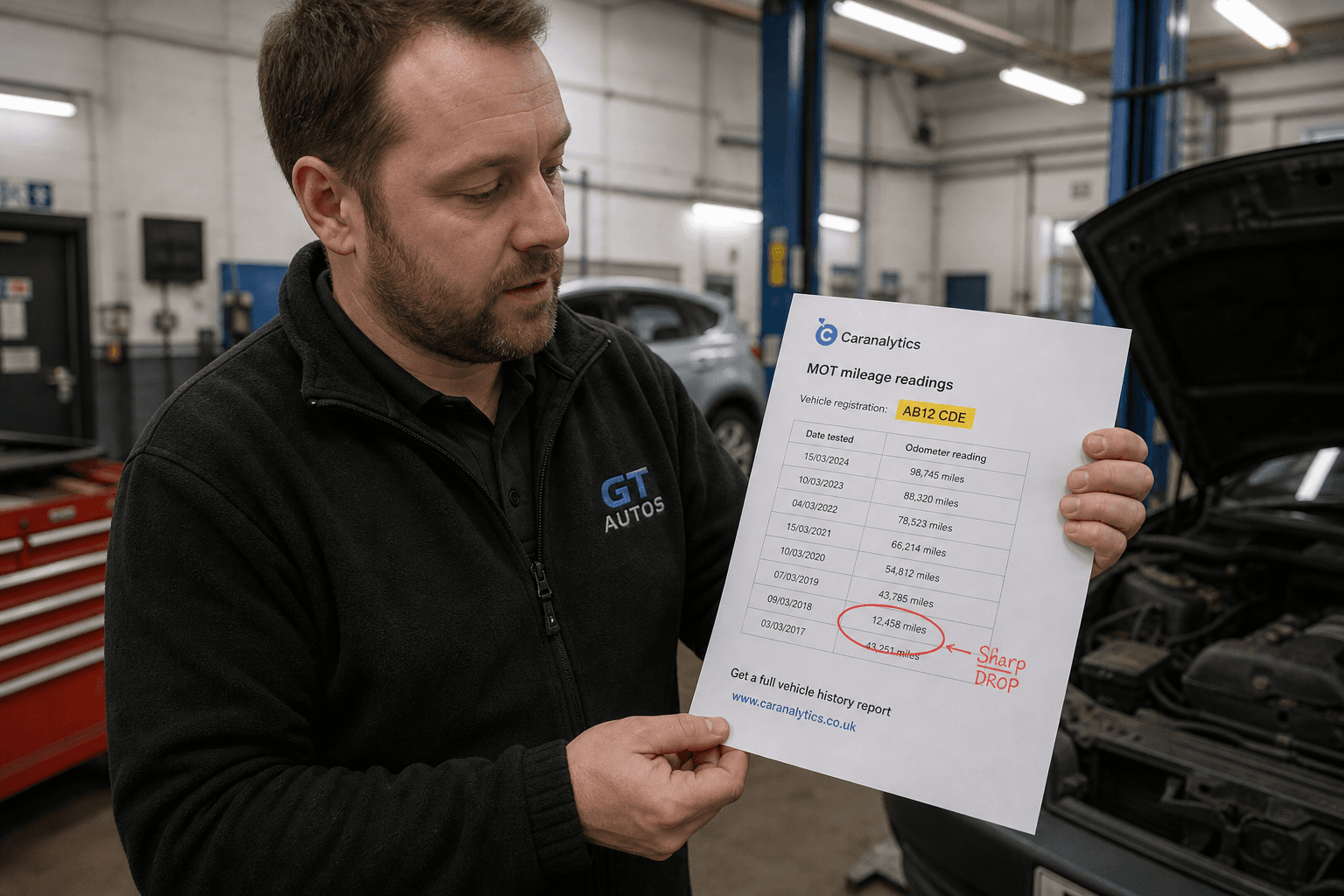
Every MOT test records the odometer reading at the time of the test. The DVSA stores this data for the life of the vehicle. When you run a history check, these readings are compiled into a mileage timeline.
A clean mileage history looks like this:
- 2018: 18,400 miles
- 2019: 26,100 miles
- 2020: 33,900 miles
- 2021: 42,200 miles
That is consistent. A car doing roughly 8,000 miles a year. Nothing unusual.
A mileage discrepancy looks like this:
- 2018: 18,400 miles
- 2019: 26,100 miles
- 2020: 33,900 miles
- 2021: 22,600 miles
That 2021 entry is a drop of over 11,000 miles. That is a mileage discrepancy. That car has almost certainly been clocked.
What Clocking Means
Clocking is the deliberate manipulation of a vehicle's odometer to show a lower reading than the car has actually covered. It is fraud under the Fraud Act 2006.
It is done to make a high-mileage car appear lower mileage, which commands a higher price. A car with 100,000 genuine miles might be worth 20 percent less than the same car at 60,000 miles. That difference is the motive.
Modern digital odometers can be reprogrammed with tools available online. The job takes under an hour.
Is a Discrepancy Always Fraud?
No. Genuine recording errors do happen. An MOT tester can read or type a figure incorrectly. A dashboard or instrument cluster replacement can result in a new unit being set to zero or an incorrect value.
But a large drop in mileage is not a typing error. A car that showed 48,000 miles one year and 31,000 the next has not had a recording error. That is a deliberate act.
Small discrepancies of a few hundred miles deserve a question. Large drops require a clear and documented explanation before you proceed.
What to Ask Before You View
If a history check shows a mileage discrepancy, contact the seller before you travel. Ask them to explain the discrepancy in writing.
A legitimate explanation - such as an instrument cluster replacement - should come with documentation. A workshop invoice, a receipt for the part, something that explains the change.
If the seller cannot explain it or gets defensive, the viewing is over. Do not let the price or the location pressure you into buying a car with unexplained mileage data.
Inconsistent Mileage Without a Drop
A discrepancy does not always mean a figure has gone down. Watch for these patterns:
- A car that accumulates 15,000 miles per year for four years then shows 1,200 miles in year five
- A car with a service history showing 85,000 miles but MOT records showing 71,000 at the same time
- A car where the claimed current mileage is lower than the last MOT reading
All of these are discrepancies. All of them require explanation.
Run the Check Before You View
A full history check at check.bad-drivers.uk gives you the complete MOT mileage timeline alongside finance, stolen, and write-off data. If the mileage history flags a discrepancy, you will see it before you waste a trip.
The full check is £9.99. A clocked car could cost you thousands in inflated purchase price and early mechanical failures on components that have worn further than the dial suggests.
Useful Links
- Consumer Rights Act 2015 - GOV.UK - Your rights when goods are not as described, including misrepresented mileage
- How to complain to a trader - Citizens Advice via GOV.UK - Find your local Trading Standards office to report mileage fraud
FAQ
What causes a mileage discrepancy on a car history check?
The most common cause is clocking - deliberately winding back the odometer to show a lower mileage. Less commonly it is a genuine recording error at an MOT test, or a dashboard replacement where the new unit was set incorrectly. A discrepancy always warrants investigation before purchase.
Is a mileage discrepancy always fraud?
Not always. Genuine errors do occur. A tester can record the wrong figure, or a digit can be transposed. But a mileage that drops significantly between tests is not a typo. Any discrepancy should be investigated before you buy. The burden of explanation sits with the seller.
What should I ask the seller if there is a mileage discrepancy?
Ask them to explain it in writing before you view. A genuine explanation, such as a dashboard replacement, should come with supporting documentation. If the seller cannot or will not explain it, treat the discrepancy as evidence of clocking and walk away.
Can I get my money back if I buy a car with a mileage discrepancy?
If the seller knew the mileage was false, you have a fraud claim under the Fraud Act 2006. You can pursue a refund through the courts and report it to Trading Standards and Action Fraud. Getting money back from a private seller is possible but not guaranteed.