A car with 96,000 miles, one owner, and a price that looks slightly too good. The seller says it was a rep's car. It was a minicab, and unless you know how to tell if a used car was an ex-taxi, you will find out about eighteen months later when the gearbox goes.
Ex-taxis are not rare on the private market and almost nobody advertises them as such. There is no legal requirement to disclose previous licensed use in a private sale, and the logbook will not tell you. The MOT record usually will.
The MOT Frequency Tell
This is the one most buyers never think to look at, and it is the strongest signal available for free.
Licensed hackney carriages and private hire vehicles are regulated by the local council, and councils impose their own testing regime on top of the standard annual MOT. Many require a full test every six months, and some require more than that on older vehicles. Those tests appear in the public DVSA record like any other.
So when you open the MOT history and see two tests within a twelve month window, repeated across three or four consecutive years, you are almost certainly looking at a licensed vehicle. Ordinary private cars get tested once a year, and the occasional early retest after a failure looks quite different because it follows a fail within days or weeks, not six months later on a pass.
Read the pattern rather than a single entry. A retest two weeks after a failure is normal. A clean pass every six months for four years is a taxi.
How to read a car MOT history covers what else the record gives away.
The Mileage Pattern
Taxi work produces mileage that does not look like anything else.
A private car averages roughly 7,000 to 12,000 miles a year. A busy private hire vehicle can do 40,000 or more. When you plot the recorded mileages from each MOT and see 35,000 to 50,000 a year for three years, then a sudden drop to 8,000 when it was sold on, you are looking at a vehicle that left licensed service and became somebody's ordinary car.
That drop is the giveaway. It is also the moment the current seller bought it, which is why they can say with a straight face that they have only done 8,000 miles a year in it.
Those miles are the worst kind, too. Urban work means constant idling, stop-start traffic, heavy braking, and short trips where a diesel particulate filter never gets hot enough to clear itself. Our guide to signs a used car has been driven hard explains why 40,000 urban miles wear a car more than 90,000 motorway miles.
Physical Evidence
Once the record has made you suspicious, the car itself confirms it.
Bolt holes and bracket marks. Council licence plates mount on the rear bumper or boot lid, and roof signs bolt to the roof. Removing them leaves holes, filled holes, or paint that does not quite match around a small rectangle.
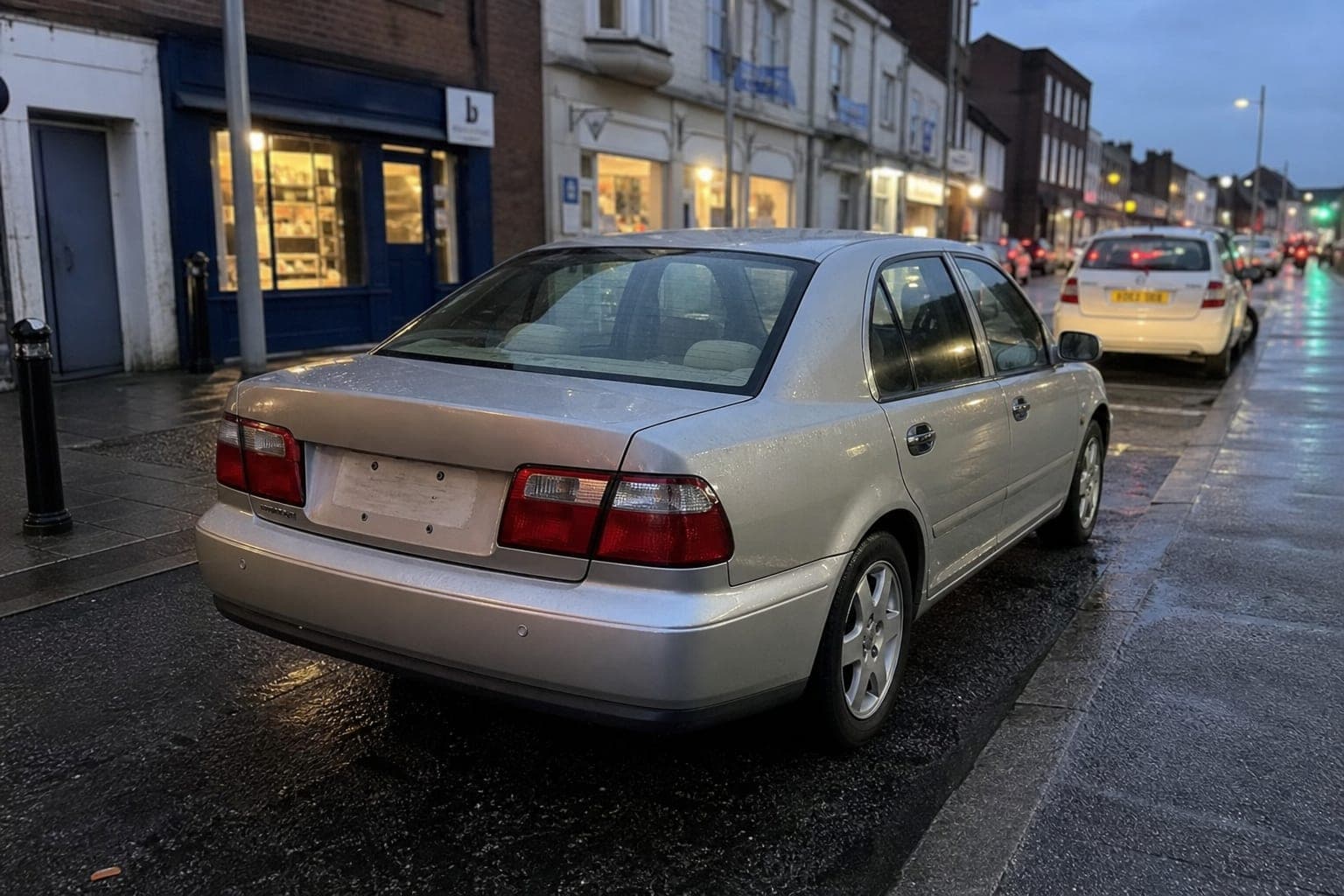
A licence plate outline. Years of a plate bolted to the same spot leaves a shadow in the paint where the surrounding panel has faded and that patch has not.
Wiring behind the dash. Meters, radios and card terminals need power. Look for cut or capped wiring around the centre console and under the dashboard, or holes in trim panels that have been plugged.
Rear seat and door wear. This is the odd one, because it is backwards from a normal car. Private cars wear out the driver's seat while the rear seats stay pristine. A car with a worn rear bench, scuffed rear door cards and marked rear sills has been carrying strangers.
Rear floor mats and scuff plates. Thousands of pairs of feet leave a very particular pattern.
Is an Ex-Taxi Worth Buying?
Sometimes, at the right money. This is not a car to avoid on principle, it is a car to price correctly.
Taxis are often maintained properly, because a vehicle off the road earns nothing and licensing inspections force the issue. A well kept ex-private hire car with recent clutch, brakes and cambelt work can be a reasonable buy for somebody who needs cheap, durable transport.
What you must not do is pay private car money for one. The wear is real, the resale is slower, and some insurers ask about previous licensed use and rate it differently. If the seller has concealed the history, that is also a reasonable indication of how the rest of the conversation is going.
The Checks That Go Beyond Condition
Wear is one thing. Whether you get to keep the car is another.
Ex-fleet and ex-hire vehicles frequently carry finance, and licensed operators often run vehicles on finance agreements that outlast their time in service. Outstanding finance, stolen markers, insurance write-off category, keeper history, plate changes and a mileage cross-reference against independent sources sit in the Full Report at £9.99.
The mileage cross-reference matters especially here, because a vehicle that covered 40,000 miles a year is exactly the sort where an odometer correction is tempting. What a mileage discrepancy means explains how those get spotted, and what a car history check shows lists everything covered.
FAQ
How can I tell if a used car was an ex-taxi?
The clearest signal is MOT frequency. Licensed taxis and private hire vehicles are usually tested more often than once a year under council licensing rules, so two tests in twelve months across several years is a strong indicator. Very high annual mileage and unexplained bolt holes on the bumpers support it.
Does the V5C say a car was a taxi?
Not reliably. The logbook records the keeper and vehicle details, not the licensed use. Some ex-taxis show a company or individual keeper with nothing unusual on the face of the document, which is why the test record matters more.
Is buying an ex-taxi always a bad idea?
No, but it must be priced as one. Taxi miles are mostly urban, with constant idling, heavy braking and frequent cold starts, so a 90,000 mile ex-taxi has usually had a harder life than a 90,000 mile private car. At the right price with recent major work it can still make sense.
Will an ex-taxi be harder to insure or sell?
It can be. Some insurers ask about previous licensed use and price accordingly, and resale is slower because informed buyers discount heavily. Factor both into what you offer rather than discovering them afterwards.
What checks should I run on a suspected ex-taxi?
Start with the free MOT history for test frequency, mileage pattern and failure history. Then run the Full Report at £9.99 for outstanding finance, stolen markers, write-off category, keeper history, plate changes and a mileage cross-reference.
Does a seller have to tell me a car was a taxi?
A private seller is under no duty to volunteer it, though they must not lie if you ask directly. A trader is held to a higher standard and describing an ex-taxi as a private car would be misleading. Ask the question explicitly and keep the answer in writing.
Useful Links
- Taxi and private hire vehicle driver licence - GOV.UK - How licensed drivers and vehicles are regulated by local councils.
- Getting an MOT - GOV.UK - What the annual test covers and how each test is recorded against the vehicle.
- Vehicle registration certificate (V5C) - GOV.UK - What the logbook records, and the details it does not capture.
- Driver and Vehicle Standards Agency - GOV.UK - The agency setting MOT standards and publishing test records.