Rust never starts where you are looking. By the time a sill is bubbling through the paint, the metal behind it has been going for three or four years and the repair is a welding job rather than a tin of touch up. Knowing where rust hides on a used car is the difference between buying a tidy ten year old motor and buying somebody else's welding bill.
The parts that matter are all underneath, and almost nobody looks.
Why the Underside Rots First
Salt. Not weather, not age, salt.
Councils grit from roughly October to April, and every one of those journeys throws a fine brine spray up into the underside of the car. It sits in box sections and seams where it never dries out, and it works on bare steel for months. The top of the car gets rained on and washed. The bottom gets salted and left alone.
We analysed every MOT test recorded in Great Britain in 2023 and the pattern is stark. Comparing cars of identical age, corrosion related failures run at 88.7 per 1,000 tests in Scotland against 20.8 in England. Corroded brake pipes alone appear around eighty times more often in the worst areas than the best. The full breakdown by postcode area is in our MOT failure study, and it is worth checking where a car has spent its life before you look at it.
The Six Places to Actually Check
Take a torch. Take an old jacket. Get on the floor. A seller who objects to that is telling you something.
Brake pipes. Rigid steel lines running the length of the floor, usually along the inner sill or down the centre tunnel. Run a gloved finger along them. Smooth is fine. Flaky, scabbed or furry means the wall thickness is going, and a brake pipe does not weep before it fails, it lets go all at once. This is the single most common corrosion failure item on the MOT.
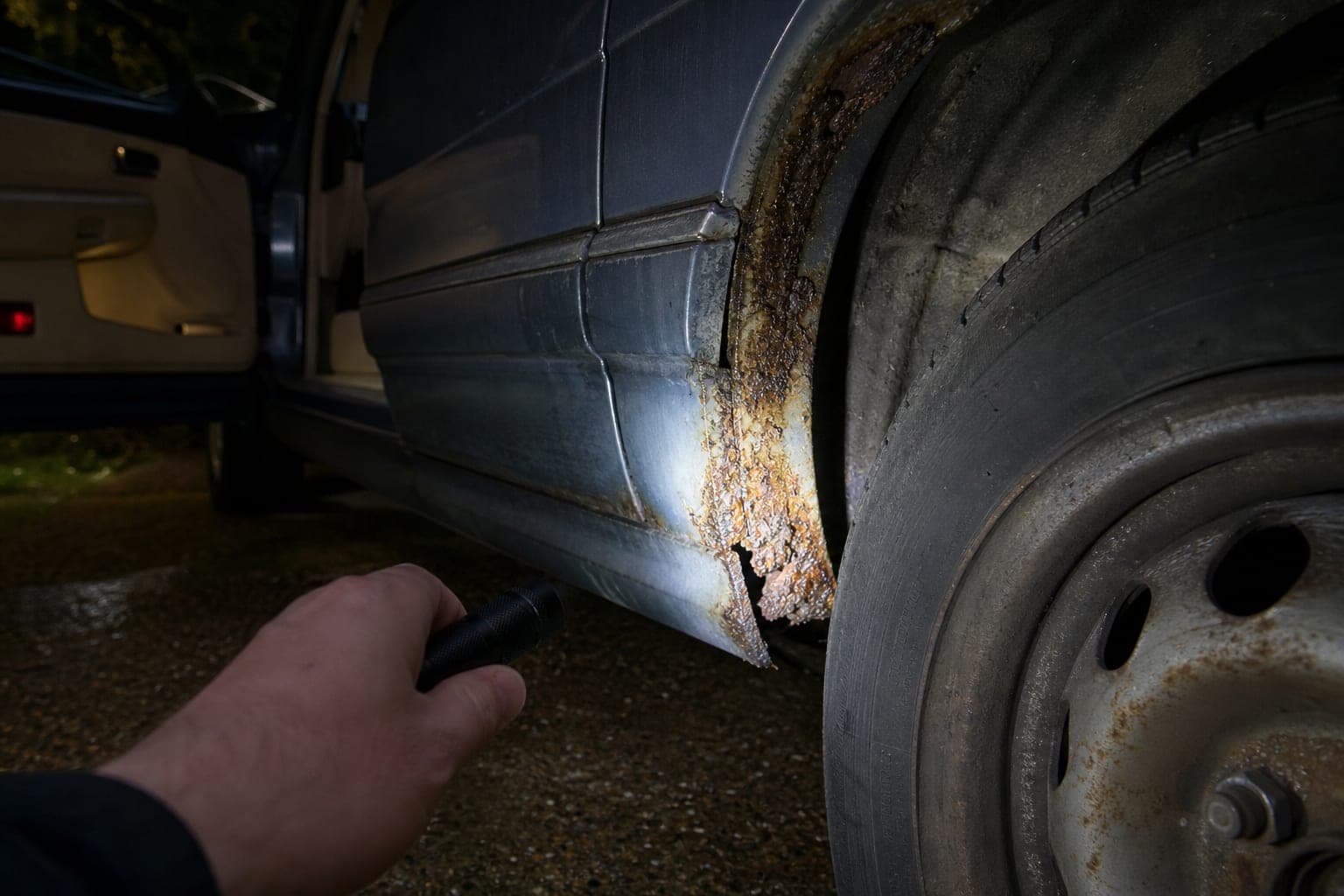
Sills and the jacking points. The outer sill is a cover panel. What matters is the inner structure behind it. Press firmly along the bottom seam and at the jacking points. Sound metal feels solid. Anything that gives, crunches or sounds hollow is rotten behind the paint.
Subframes and suspension mounting points. Front and rear subframes carry the suspension and steering. Look where the arms bolt on. Surface fuzz is normal. Layered flaking, holes or a bolt sitting in a crater is structural, and it sits inside the prescribed area that fails an MOT outright.
Boot floor and spare wheel well. Lift the boot carpet and the spare. Water gets in through failed light seals and tailgate seals and sits in the well for years. A damp or stained well is a warning even before the rust shows.
Door bottoms and the tailgate. Drain holes block with dirt, water sits inside the door skin, and it rots from the inside out. Feel along the bottom edge of each door, inside and out.
Rear arches and the seam above them. Mud packs into the lip and holds moisture against the metal permanently.
What Fails an MOT and What Does Not
This trips people up, so it is worth being precise.
Surface rust on a wing or a bonnet is cosmetic. It does not fail. It looks bad and it will get worse, but the tester is not interested.
Corrosion fails when it is structural or when it affects a safety component. That means metal within 30cm of a suspension or seatbelt mounting point, referred to as a prescribed area, or a brake pipe, a suspension arm, a spring mounting, a steering component or a subframe that has been weakened.
The practical version: rust you can see on a panel is a price negotiation. Rust you can feel underneath on something that bolts the wheels to the car is a walk away.
Read the Record Before You Read the Metal
The MOT history is public and free, and corrosion shows up in it years before it shows up on a forecourt.
Testers write advisories in plain terms. Slight corrosion, corroded but not seriously weakened, and similar wording appears long before anything fails. A car carrying corrosion advisories across three or four consecutive tests is a car that is quietly rotting, and the seller has had every one of those warnings.
Pull the record for any car before you drive to see it. How to read a car MOT history covers the entries, and what MOT advisories mean covers the tester wording. It costs nothing and it saves the trip.
The Underseal Question
Fresh black underseal on a fifteen year old car is the most common way corrosion gets hidden from a buyer.
Sometimes it is genuine preventative work by an owner who cares. Often it is a coat of thick rubberised paint sprayed straight over flaking rust a fortnight before sale, which traps moisture against the metal and accelerates everything underneath it.
Tell them apart by looking at the edges and the awkward bits. Proper work is thin, even, and reaches into the seams. A cover up is thick, uneven, sprayed over dirt, and stops wherever the person holding the gun got bored. Press it. If it gives underneath, there is nothing solid behind it.
Ask when it was done and by whom. An honest owner has an answer.
Pricing It
Rust is not automatically a reason to walk. It is a reason to know what you are buying.
Surface corrosion on a subframe of a ten year old car is normal and not worth much off the price. Flaking on brake lines is a set of pipes and a day's labour. A rotten sill is welding and MOT work that runs into four figures on some cars and is worth more than the car on others.
What you must not do is pay clean car money for a car that will need structural welding at its next test. Our guide to signs a used car has been driven hard covers the wider condition picture, and what a car history check shows sets out what the paid Full Report at £9.99 adds on top, including write-off category and mileage cross-referencing.
FAQ
Where does rust hide on a used car?
Underneath, mostly. Brake pipes running along the floor, the sills and their inner structure, subframes and suspension mounting points, the boot floor under the spare wheel, and the bottoms of doors. Visible bubbling on a panel usually means the metal behind it has been rotting for years.
Can rust fail an MOT?
Yes. Corrosion fails the test when it affects a prescribed area, meaning structure within 30cm of a suspension or seatbelt mounting, or when it weakens a brake pipe, suspension component or other safety item. Cosmetic surface rust on a wing does not fail.
Does the MOT history show rust problems?
It does, and it is free to view. Corrosion appears in advisory and failure text long before a panel bubbles, so a car with corrosion advisories across several years is telling you what is coming. Read the whole record rather than the last test.
Is underseal a good sign or a bad one?
Both, and that is the problem. Factory underseal on a well kept car is fine. Thick fresh underseal on an older car sold privately is worth questioning, because it is the cheapest way to hide corrosion from a buyer who will not crawl underneath.
Is a rusty car always a bad buy?
No, but it must be priced for it. Surface rust on a subframe is normal on a ten year old car. Flaking layers, holes, or corrosion on brake lines and mounting points are structural and expensive, and those are the ones to walk away from.
Does where a car was driven affect how rusty it is?
Heavily. Cars from areas that grit hard and long carry far more corrosion at the same age than cars from areas that barely salt at all. The postcode area on the MOT record tells you roughly where a car has spent its life.
Useful Links
- Getting an MOT - GOV.UK - What the annual test inspects, including the structural areas corrosion is assessed against.
- MOT test results - GOV.UK - How pass, fail and advisory outcomes are recorded against a vehicle.
- Driver and Vehicle Standards Agency - GOV.UK - The agency that sets MOT testing standards and publishes tester guidance.
- Vehicle approval - GOV.UK - Guidance covering structural repairs and substantially modified vehicles.