
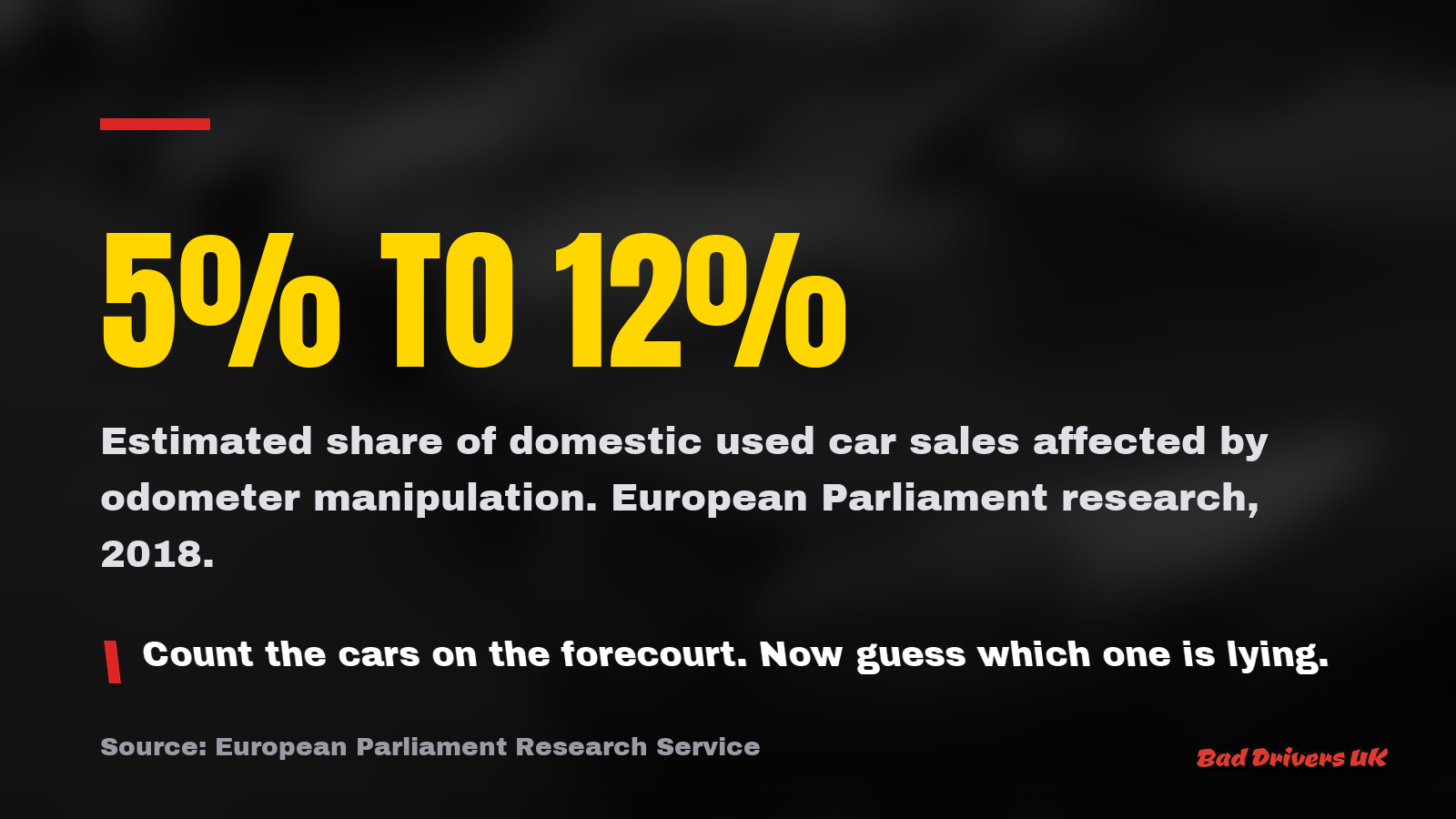
Strip out the anecdotes and the trade gossip, and the most sober estimate of mileage fraud comes from an unlikely place: the European Parliament's own research service. Its study of odometer manipulation concluded that between 5 and 12 per cent of domestic used car sales are affected. At the top of that range, that is one tampered car in every eight sold.
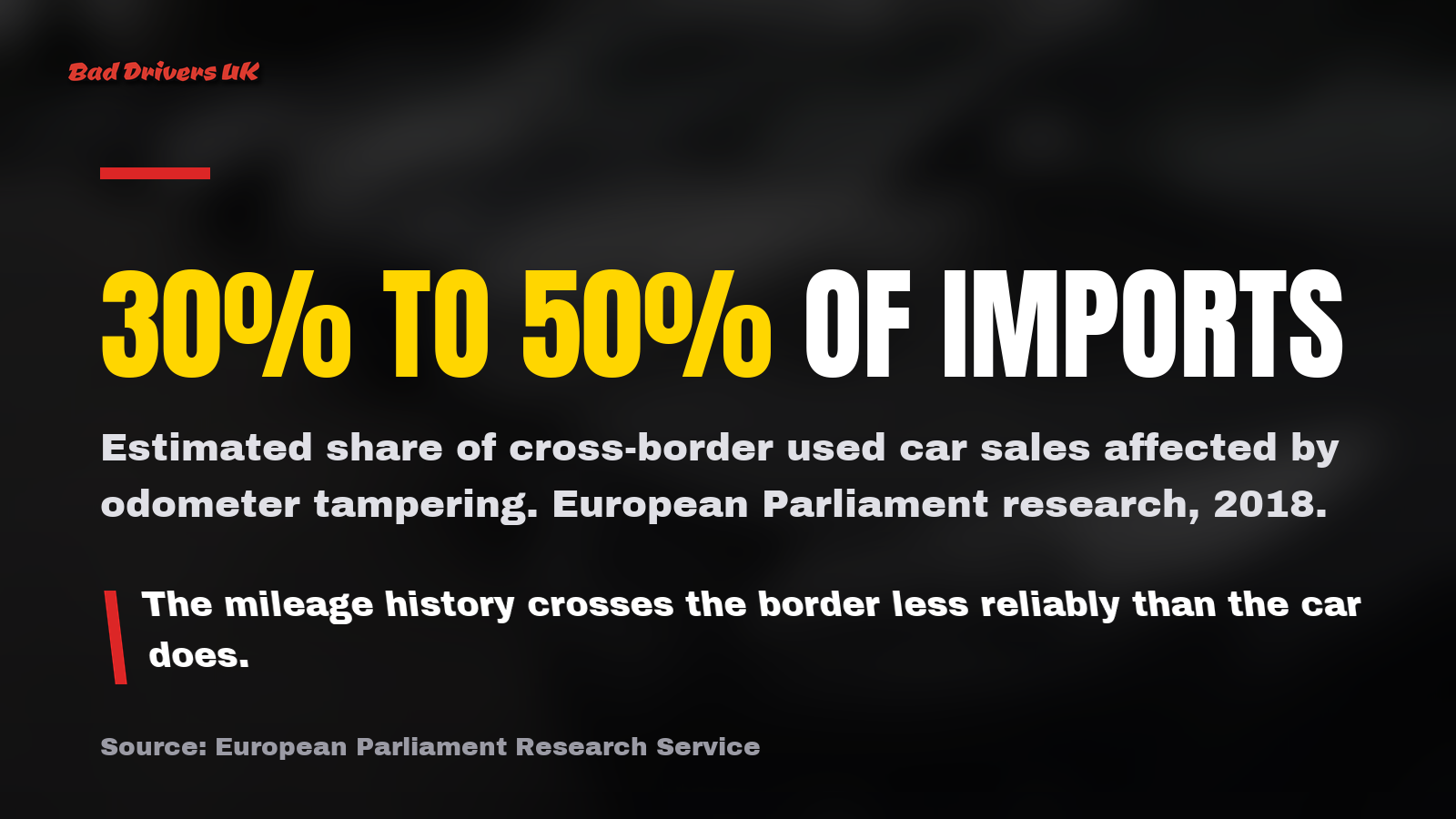
Cross a border and it gets dramatically worse: an estimated 30 to 50 per cent of cross-border used car sales involve a manipulated odometer. The full study was published in 2018 to support EU-level action, and its numbers remain the most rigorous public estimate of how deep this fraud runs.
 European Parliament Research Service, 2018
What Those Percentages Look Like on a Forecourt
Numbers that size stop being abstract the moment you put them in a car park. Twenty cars in a row at the bottom of the estimate means one of them is lying to you. At the top of the range it is two or three. None of them look any different from the outside, which is the entire point of the crime.
A mileage discrepancy is a recorded reading that does not fit the car's own history: an MOT that logs fewer miles than the year before, a service invoice that disagrees with the dial. Our guide to mileage discrepancies walks through the patterns. Not every discrepancy is fraud, testers typo figures and instrument clusters get replaced, but a car that officially travelled backwards has a story to explain, and the burden of that explanation sits entirely with the seller.
The Case That Shows How It Is Done
If the research gives the scale, a UK courtroom gave the method. In February 2026, Oxford Crown Court sentenced a van trader who had rolled back the odometers on six ex-fleet vans, the £20,000 clocking case we covered in full.
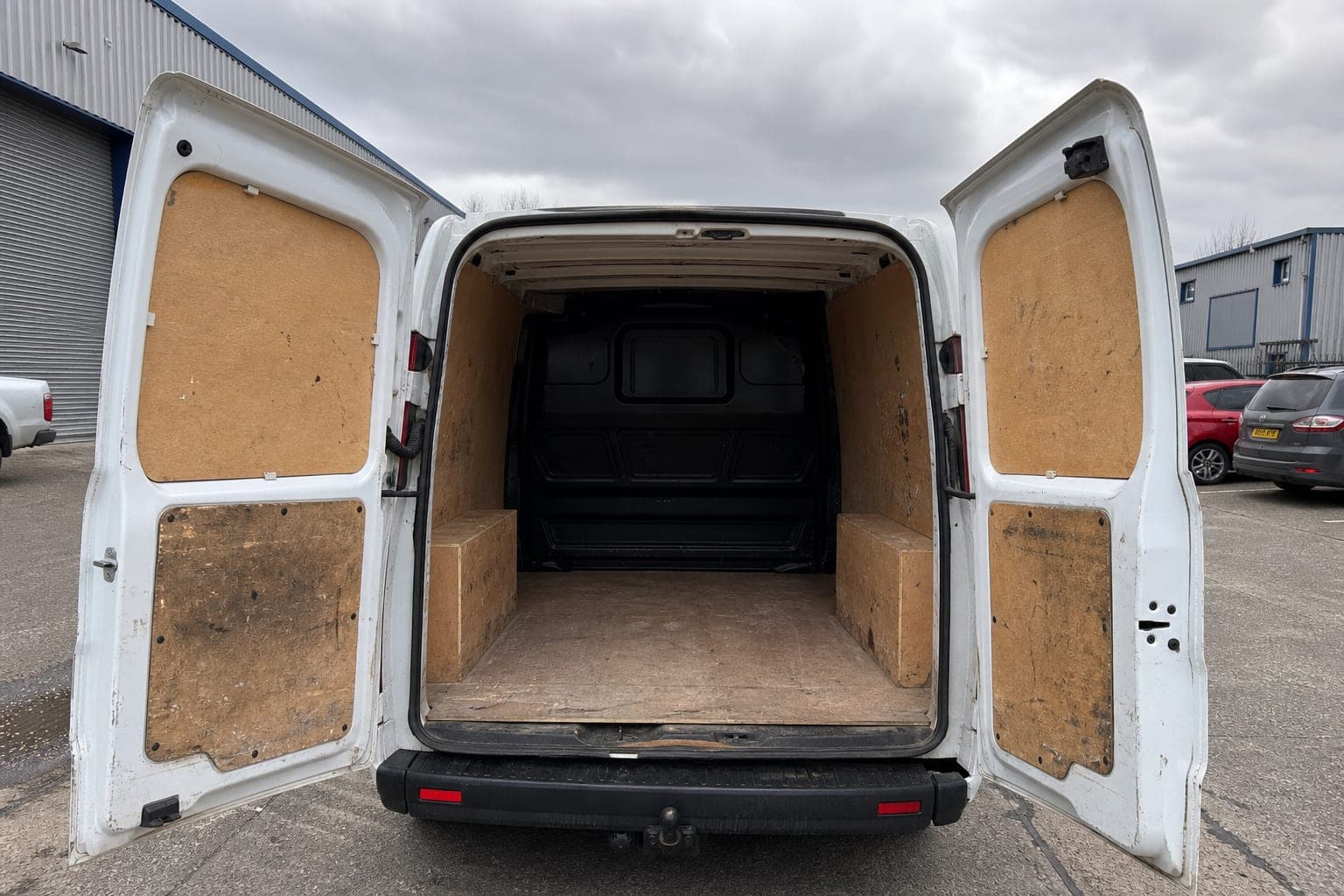
His playbook is the national problem in miniature. He bought high-mileage fleet vans under three years old, young enough that no MOT record existed to contradict the dial. He wound each odometer back to sit just above the last service entry, so the paperwork agreed with the lie. Then he sold them as tidy low-mileage vans, £20,000 better off, until Trading Standards caught up and a judge handed him an 18 month suspended sentence.
Every element generalises: pick stock with a thin paper trail, make the visible records consistent, price temptingly, sell fast. The percentages in the Parliament study are thousands of small operations exactly like his.
Why Clocking Keeps Paying
The value gap is the engine. Knocking 40,000 miles off a dial adds thousands to the apparent value of an ordinary car, and the tools to do it are software, cheap and openly sold. Altering a reading is not even illegal in itself, there are legitimate uses when a cluster fails. Selling without declaring the true figure is the fraud, and it is the selling that pays.
Finance quietly feeds it. Mileage-capped deals such as PCP charge for every mile over the allowance, so a driver running over their cap has a four-figure reason to wind the number back before handover. Our guide to PCP finance explains the caps. The consequence is uncomfortable: clocking pressure concentrates on the newest, tidiest cars, exactly the stock buyers assume is safest.
Borders erase the evidence. A car's mileage history lives in national records and paperwork. When the car migrates, its history often does not, which is how the cross-border tampering estimate reaches 30 to 50 per cent. If you are shopping an import, treat the mileage as unverified until proven otherwise, and read our guide to buying a grey import before you fall for the spec sheet.
 European Parliament Research Service, 2018
How to Not Buy the Tampered One
The defence does not change with the car's age, but the emphasis does:
- Pull the recorded mileage history before you view. For cars over three years old, the MOT trail gives year-by-year readings, and our guide to what a mileage check shows explains how to read it. A drop, or a year that is suspiciously flat, ends the conversation.
- For under-threes, chase the paperwork. No MOT trail exists yet, the Oxford case ran entirely inside that gap. Demand service invoices with recorded mileages, ask who ran the vehicle, and get the seller's stated mileage in writing. A returned lease car has a documented handback figure. Ask for it.
- Treat imports as unverified by default. Ask for the overseas service history and registration documents, and expect gaps. Price the risk in, or walk.
- Match the wear to the number. Pedal rubbers, steering wheel, seat bolsters, stone chips. A 20,000 mile car with a 70,000 mile interior is telling the truth even while the dial lies. Our guide to spotting a clocked car covers every tell.
- Be most suspicious of the best story. One owner, low miles, full history, keen price. Clocking exists to build exactly that story, because it is the one that sells fastest.
Up to one in eight domestic sales, up to half of some imports, and a court case that shows the method working until the moment it did not. The tampered car on the forecourt is counting on nobody checking. Check.
Useful Links
- Consumer protection rights - GOV.UK - Your rights when a vehicle's mileage is misrepresented
- Find your local Trading Standards office - GOV.UK - Report a seller advertising a false mileage
- Being charged with a crime - GOV.UK - How clocking prosecutions proceed through the courts
FAQ
How common is odometer fraud?
Research by the European Parliament's research service estimates that odometer manipulation affects between 5 and 12 per cent of domestic used car sales, and between 30 and 50 per cent of cross-border sales. At the top of that domestic range it is roughly one tampered car in every eight sold.
Why are imported used cars a higher mileage fraud risk?
Because the mileage record often does not travel with the car. A vehicle's odometer readings sit in national databases and paperwork, and when the car crosses a border that history thins out or vanishes, which is why the European Parliament research put cross-border tampering at 30 to 50 per cent of sales.
Is altering an odometer illegal in the UK?
Altering the reading is not in itself illegal, and there are legitimate reasons to correct a faulty instrument cluster. Selling a vehicle without declaring its true mileage is fraud, and UK traders have received suspended prison sentences for exactly that.
Why do people clock cars in the first place?
Money, from two directions. A lower reading adds thousands to a car's apparent value at sale. And mileage-capped finance deals such as PCP charge penalties for exceeding the allowance, which tempts drivers to wind the figure back before handing the car over.
How do I protect myself from buying a clocked car?
Pull the recorded mileage history before viewing, match the service paperwork against the dial, and compare the physical wear, pedals, steering wheel, seat bolsters, against the claimed mileage. For cars too young to have an MOT history, demand documented evidence of who ran the vehicle and the mileage when they parted with it.